The Complete Guide to Trademark Registration
What it costs, how long it takes, and what actually happens after you file — from a flat-fee trademark attorney, no jargon.
What Is a Trademark?
A trademark is anything that tells a customer where a product or service actually comes from.
That's the whole definition, and it's worth sitting with — most confusion about trademarks comes from not knowing what they're actually for. A trademark isn't protecting your idea. It's protecting the signal your customers use to find you again.
What a trademark is not is just as important. It's not a copyright, which protects original creative expression. It's not a patent, which protects an invention. And it's not the same thing as forming an LLC — the mix-up that trips up more founders than anything else on this page. Forming "Riverside Coffee LLC" gives you a legal entity by that name. It gives you zero enforceable right to stop someone else from opening "Riverside Coffee Co." two states over, or registering "Riverside Coffee" before you do.
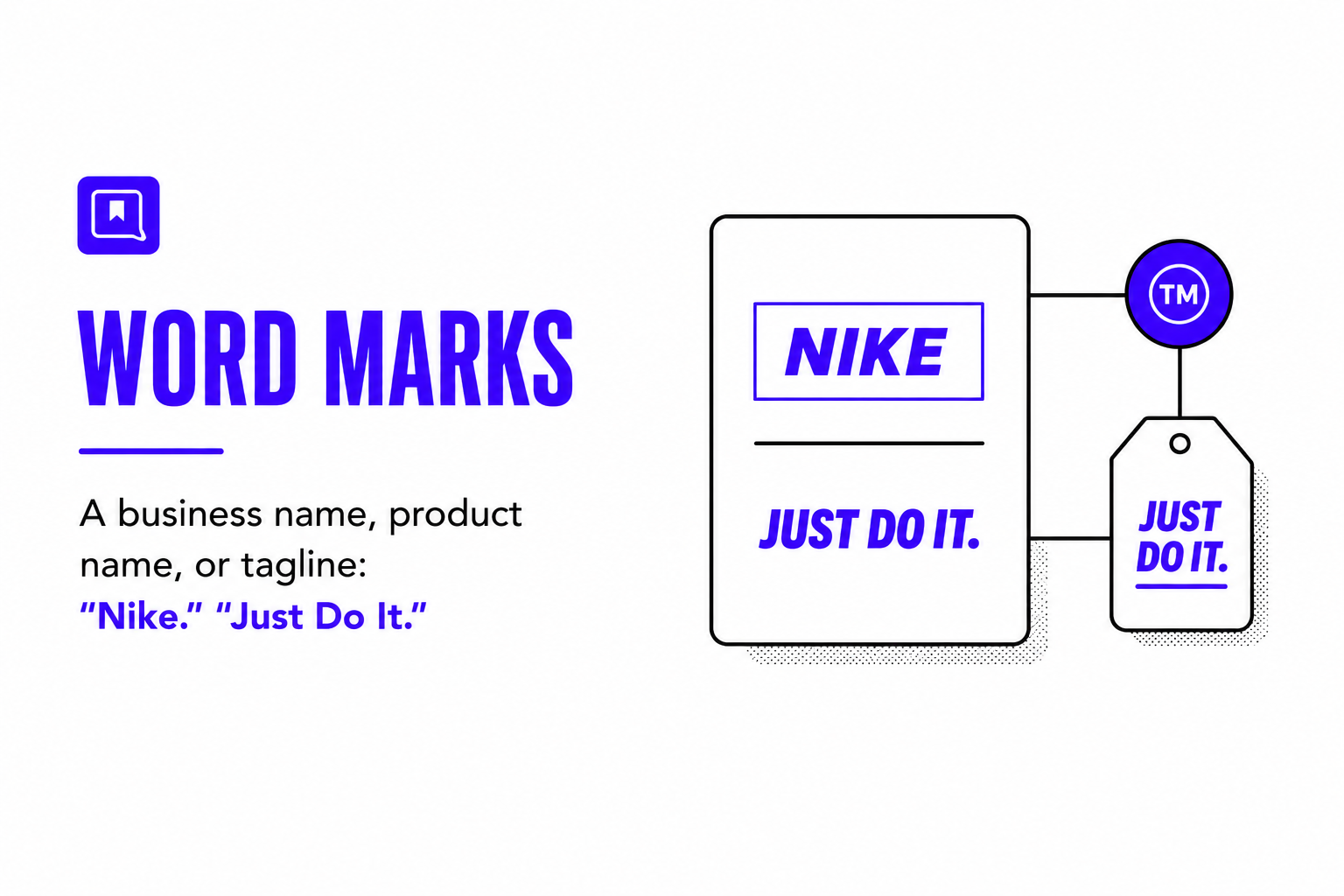
Word Marks
A business name, product name, or tagline — "Nike." "Just Do It."
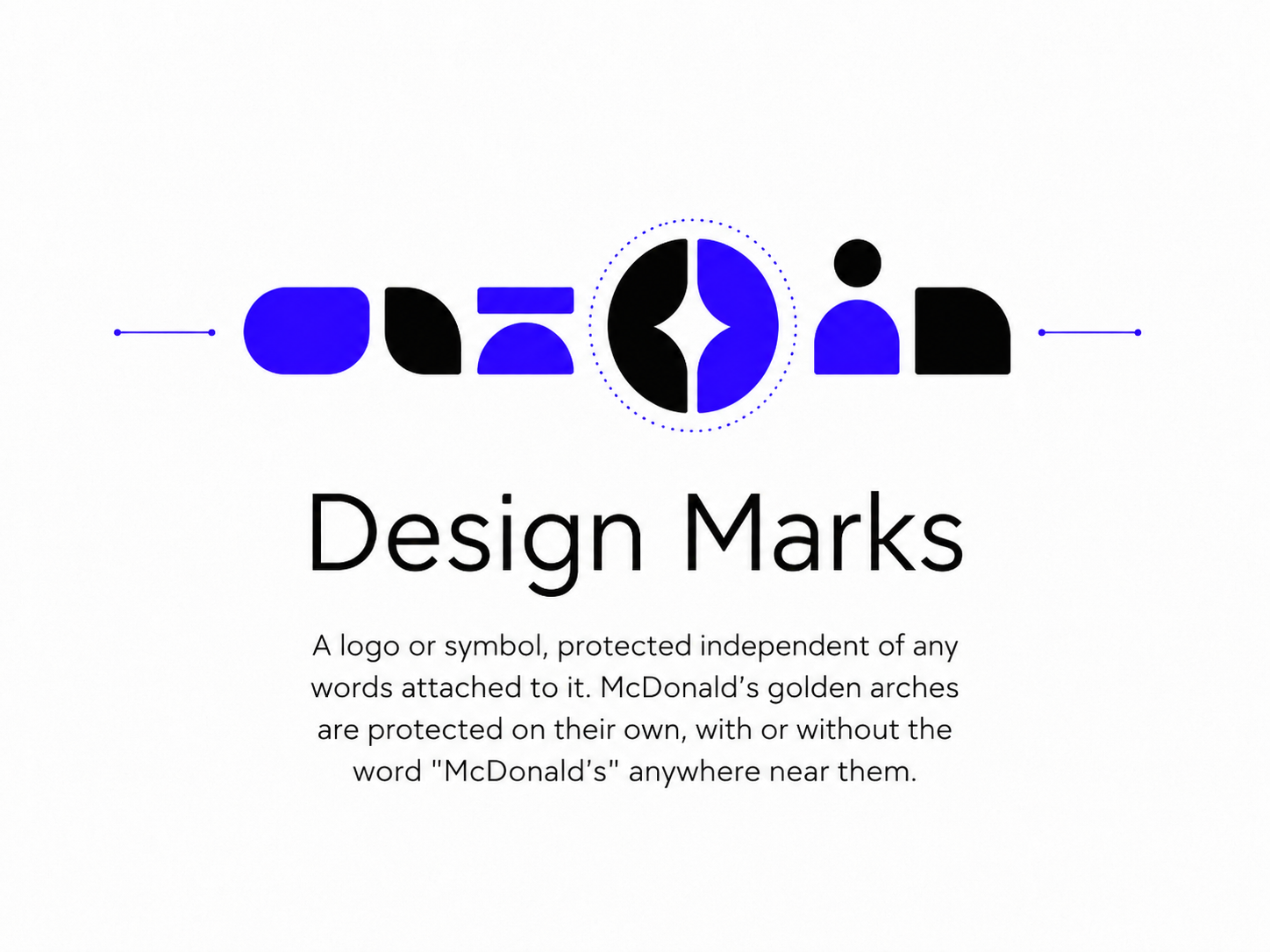
Design Marks
A logo or symbol, protected independent of any words attached to it. McDonald's golden arches are protected on their own, with or without the word "McDonald's" anywhere near them.
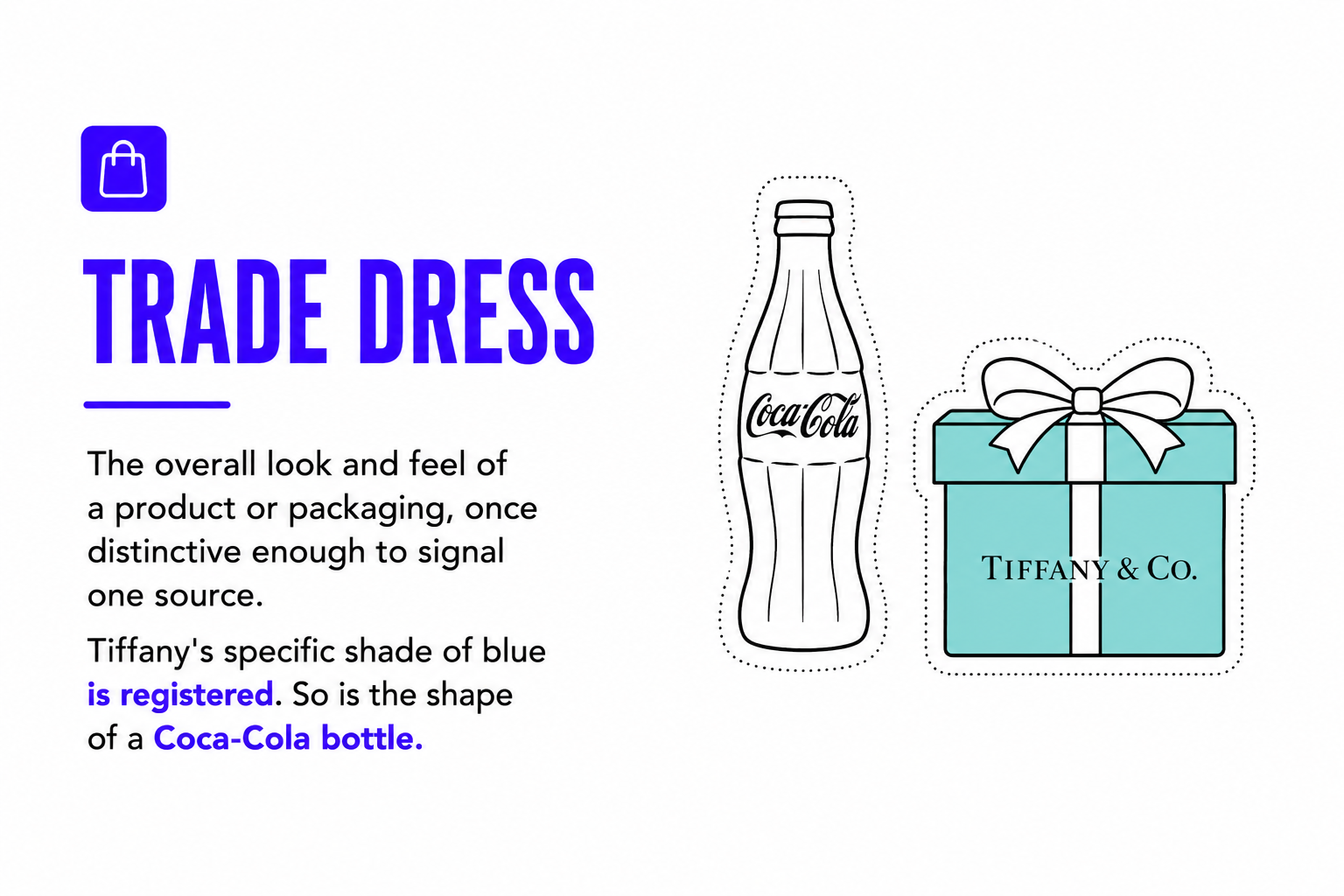
Trade Dress
The overall look and feel of a product or packaging, once distinctive enough to signal one source. Tiffany's specific shade of blue is registered. So is the shape of a Coca-Cola bottle.
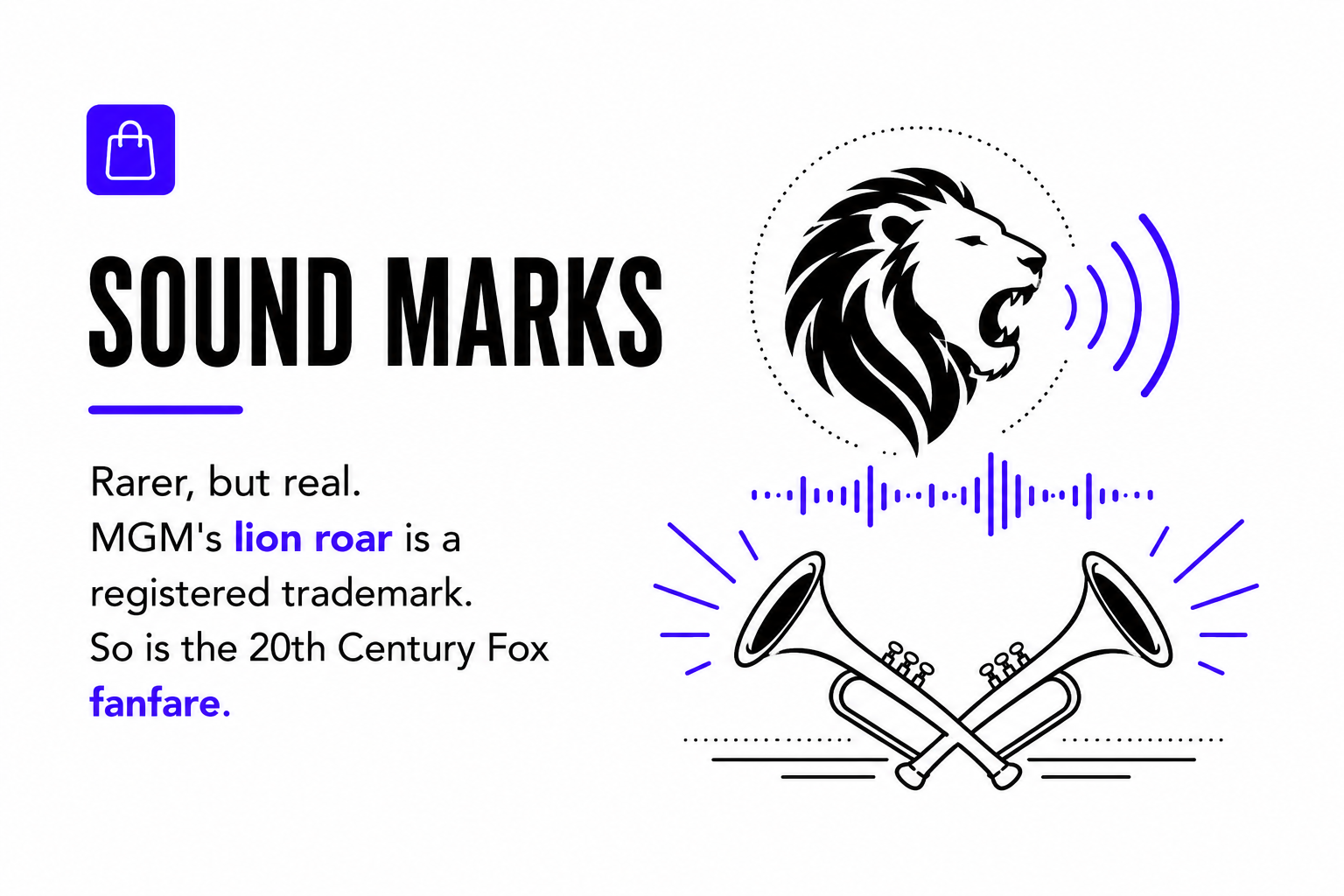
Sound Marks
Rarer, but real. MGM's lion roar is a registered trademark. So is the 20th Century Fox fanfare.
Some Names Are Easier to Protect Than Others
Before you pick a name, know where it sits on the spectrum — it decides how hard the USPTO will fight you on it.
Not every name gets the same level of protection, and this is the part nobody explains before someone falls in love with a name. Trademark strength runs on a five-point scale, and where your name lands on it decides whether it can be registered at all, how much it costs to defend later, and how wide a lane you actually get to protect.
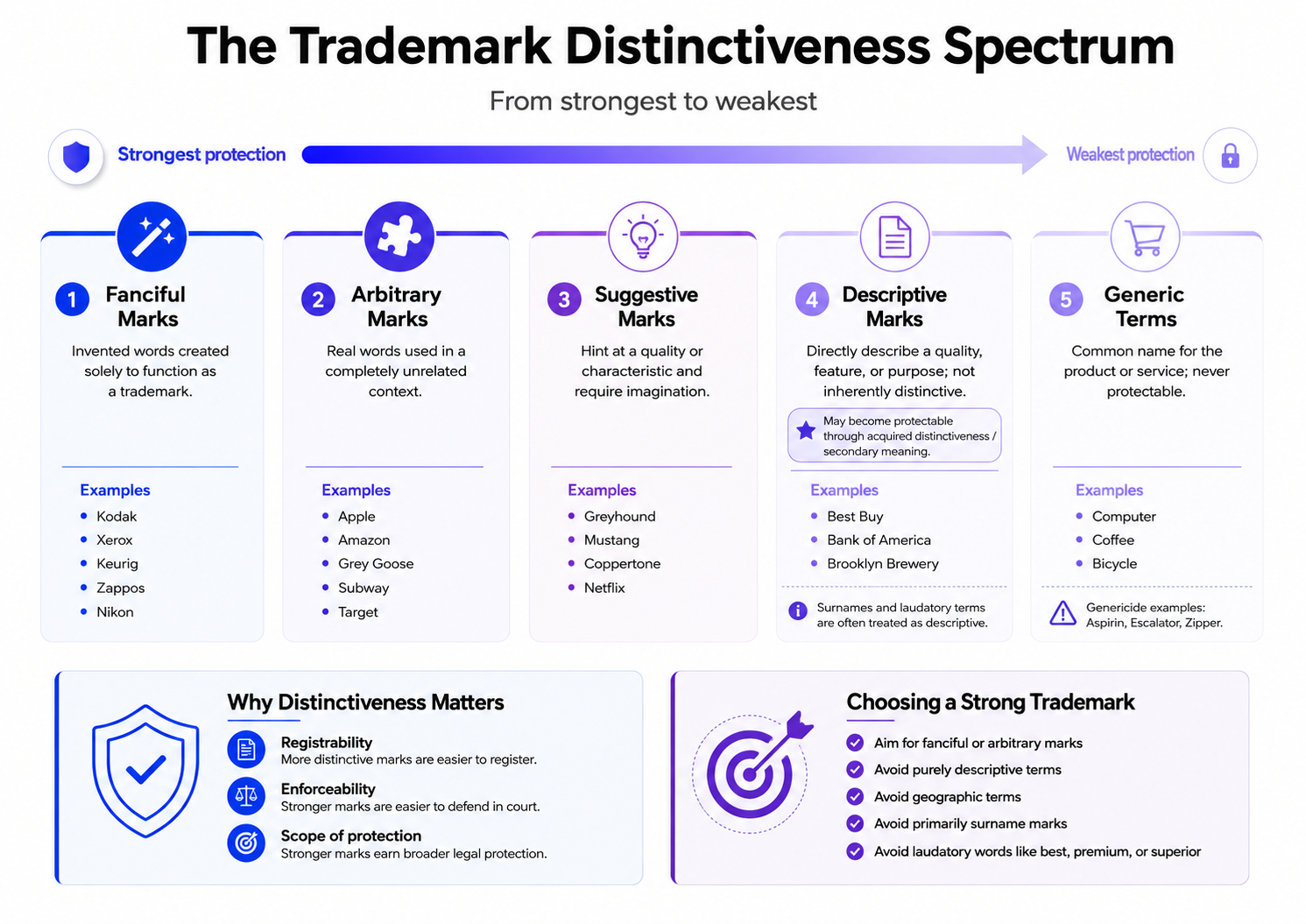
Fanciful (Strongest)
Invented words that meant nothing before you made them mean something. There's no dictionary definition to fight over, which is exactly why these get the widest protection available.
Examples: Kodak, Xerox, Keurig, Zappos, Nikon
Arbitrary (Very Strong)
Real words, used somewhere they have no business being. The word already exists, it just has nothing to do with what you're selling — and that gap is what makes it strong.
Examples: Apple (computers), Amazon (retail), Grey Goose (vodka), Subway (restaurants), Target (retail)
Suggestive (Strong)
A hint, not a description. It takes a small mental leap to connect the name to the product, and that leap is what keeps it protectable. This is also the tier where it's genuinely not always clear-cut whether a name counts as suggestive or crosses into merely descriptive.
Examples: Greyhound (buses), Mustang (cars), Coppertone (tanning lotion), Netflix (streaming)
Descriptive (Weak)
Describes the thing outright, which is exactly the problem — it isn't inherently distinctive, and the USPTO won't register it right away. It can still become protectable later through "secondary meaning": once customers associate the name with you specifically, not just the product category. Surnames get treated the same way, and so do words like "best," "premium," or "superior."
Examples: Best Buy, Bank of America, Brooklyn Brewery — enforceable today because they built secondary meaning over time, not because they were protectable on day one.
Generic (Not Protectable)
The actual name of the thing. No one gets to own it, ever — letting one company own the common word would box every competitor out of describing what they sell. A strong trademark can even end up here over time if the public starts using the brand name as the generic word for the product. It's called "genericide."
Examples: "Computer" for a computer. Former trademarks lost this way: Aspirin, Escalator, Zipper.
Why this actually matters: where your name lands on this scale decides three real things — whether it can be registered at all without years of buildup first, how much it costs to enforce against a copycat later, and how wide a net you actually get to throw around similar names. A fanciful or arbitrary mark is cheaper and easier to defend than a descriptive one, full stop.
When a client asks me to help pick a name, the advice is usually the same: reach for something fanciful or arbitrary if you can. It's the name most likely to clear the USPTO without a fight, and the easiest to defend once it's yours. If there's a real business reason to lean descriptive — customers instantly understanding what you do at a glance — that's a legitimate call. Just know what you're trading away going in, not after an office action tells you.
A few things worth avoiding on principle: names that just describe what you sell, geographic terms ("Michigan Auto Parts"), names built mostly around a surname ("Smith's Coffee"), and words like "best" or "premium" doing the marketing for you. All of them make the application harder, not just the marketing.
Why this matters before you file: the name your marketing team loves and the name a trademark examiner will approve aren't always the same name. Founders come to me after they've already printed the merch, and by then changing course costs a rebrand instead of a filing fee. Run this check before the name is locked in, not after.
What Your Registration Actually Covers
Registering the name doesn't mean you own the word. It means you own it for what you actually sell.
A trademark registration isn't a blanket claim on a word everywhere, for everything, forever. It's tied to two things: the specific goods or services you listed, and whether someone else's use is close enough to actually confuse a customer.
That's why "Delta" is a registered trademark for an airline and, separately, for a faucet company, and neither one has to fight the other over it. Different goods, no real chance a customer confuses a kitchen faucet for a flight booking. The registration protects you inside your actual lane — not the whole dictionary.
The flip side matters just as much: your registration is only as strong as the goods and services you actually listed when you filed. Expand into something new later — a different product line, a different service — and that expansion isn't automatically covered. That's a new clearance question, not an assumption.
This is also the standard behind almost every dispute you'll ever hear about: not "did they use my exact name," but "would a customer reasonably think these two things came from the same source." Same name, wildly different lane, usually no real conflict. Same name, adjacent lane, that's where it gets contested.
Do You Actually Need to Register?
The moment you use a name in commerce, you have some rights to it automatically. The problem is what those rights actually cover. The cost of registering now is fixed and known. The cost of not registering compounds with your own success — the bigger your brand gets before you register, the more expensive it is if someone else already owns the name.
Common Law Rights (unregistered)
- Limited to your specific geographic area only
- No public record — you prove usage history every time
- Expensive and slow to enforce against a copycat
Federal Registration
- Nationwide presumption of ownership
- Public USPTO record discourages conflicts before they start
- Burden of proof shifts to the other side in a dispute
How to Trademark a Name (and a Logo)
Four steps, in order — skipping one is where the expensive mistakes happen.

A knockout search catches identical or near-identical marks fast. A full clearance search goes further — USPTO database, state registrations, and common-law use that never got federally registered but could still block you.

45 international classes cover every category of goods and services. Wrong or missing classes are one of the most expensive mistakes to fix after filing. Read the full breakdown of trademark classes.
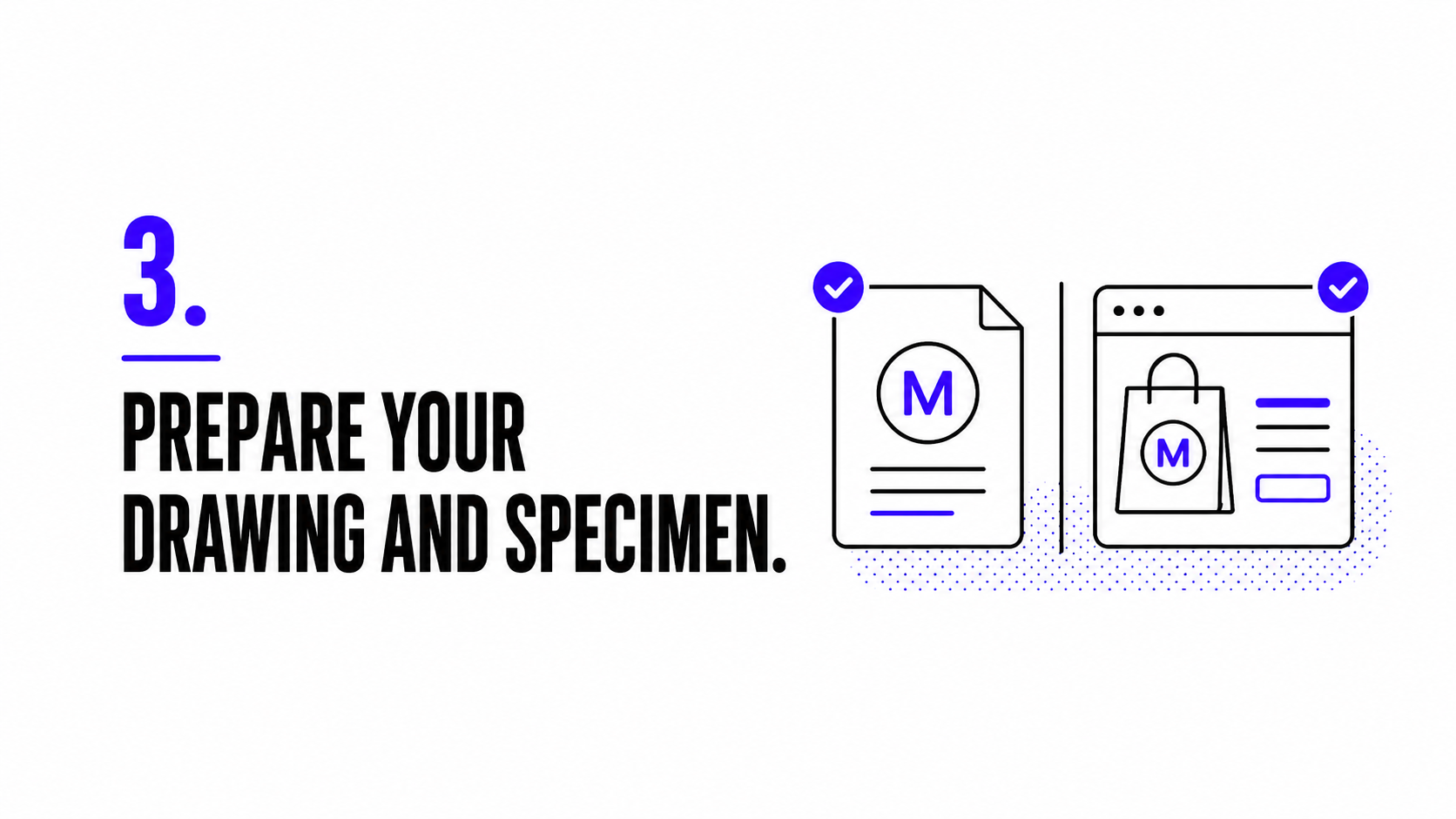
These are two different things, and mixing them up is a common, quiet mistake. The drawing is how you're claiming the mark itself — as plain text ("standard character," which covers the words no matter the font or color) or as a specific design ("special form," which locks in the exact stylization, color, and layout). The specimen is separate proof that you're actually using it: for goods, a photo of the real product with the mark visible; for services, usually a screenshot showing the mark used to offer the service. USPTO formatting rules on both are strict.
On a "use in commerce" basis if you're already selling, or "intent to use" if you haven't launched yet.
Name and logo should almost always be filed as two separate applications. Here's why it actually matters, not just as a rule to follow: if you file your name and logo together as one combined mark, you're protecting that exact combination — not the name by itself, and not the logo by itself. Change the logo later and the registration doesn't travel with you; you're starting that protection over. File them separately, and your name stays protected through every rebrand and every new logo you ever run, and your logo stands on its own too.
Who Should Actually Own the Trademark?
The application asks. Most founders haven't thought about it yet.
Before you file, someone has to be named as the owner on the application — and it's not automatically your business.
File the trademark in your own name personally, and you're on the hook personally if a dispute ever comes up. Untangling that later — moving ownership into an LLC or corporation after the fact — is its own paperwork problem, not a quick fix.
Most founders are better off having the business entity own the mark, not the individual. If you've already formed an LLC or corporation, that's usually the right owner on the application. If you haven't formed one yet, that's a conversation worth having before you file, not after.
It's a five-minute decision at filing time. It's a much longer one to unwind later.
The Mistakes That Actually Sink Applications
Most refusals aren't bad luck. They're the same handful of errors, over and over. Most trademark applications don't get rejected because the idea was bad. They get rejected — or delayed for months — because of a handful of avoidable errors that show up constantly:
-
The specimen doesn't match reality. A mockup, a design proof, or a photo that doesn't actually show the mark being used to sell the real thing. The USPTO wants proof of actual use in commerce, not a rendering of what you plan to do.
-
The goods and services description is too broad, too vague, or just wrong. Listing "clothing" when you only sell hats, or copying language from a competitor's registration that doesn't actually match what you do, both create problems an examiner will flag.
-
The drawing doesn't match how the mark is really used. Filing as plain text when you actually need the specific design protected — or the reverse — is a common, quiet mistake that shows up later.
-
Someone files the wrong basis. Claiming you're already using the mark in commerce when you technically aren't yet, or filing based on a future intent without actually having one, both create problems that surface later, not immediately.
-
The application goes out under the wrong owner. Circles back to the ownership question — an application filed in the wrong name has to be corrected, and depending on timing, that correction isn't always simple.
The Registration Process, Step by Step
Clearance search, filing, examination, publication, registration.
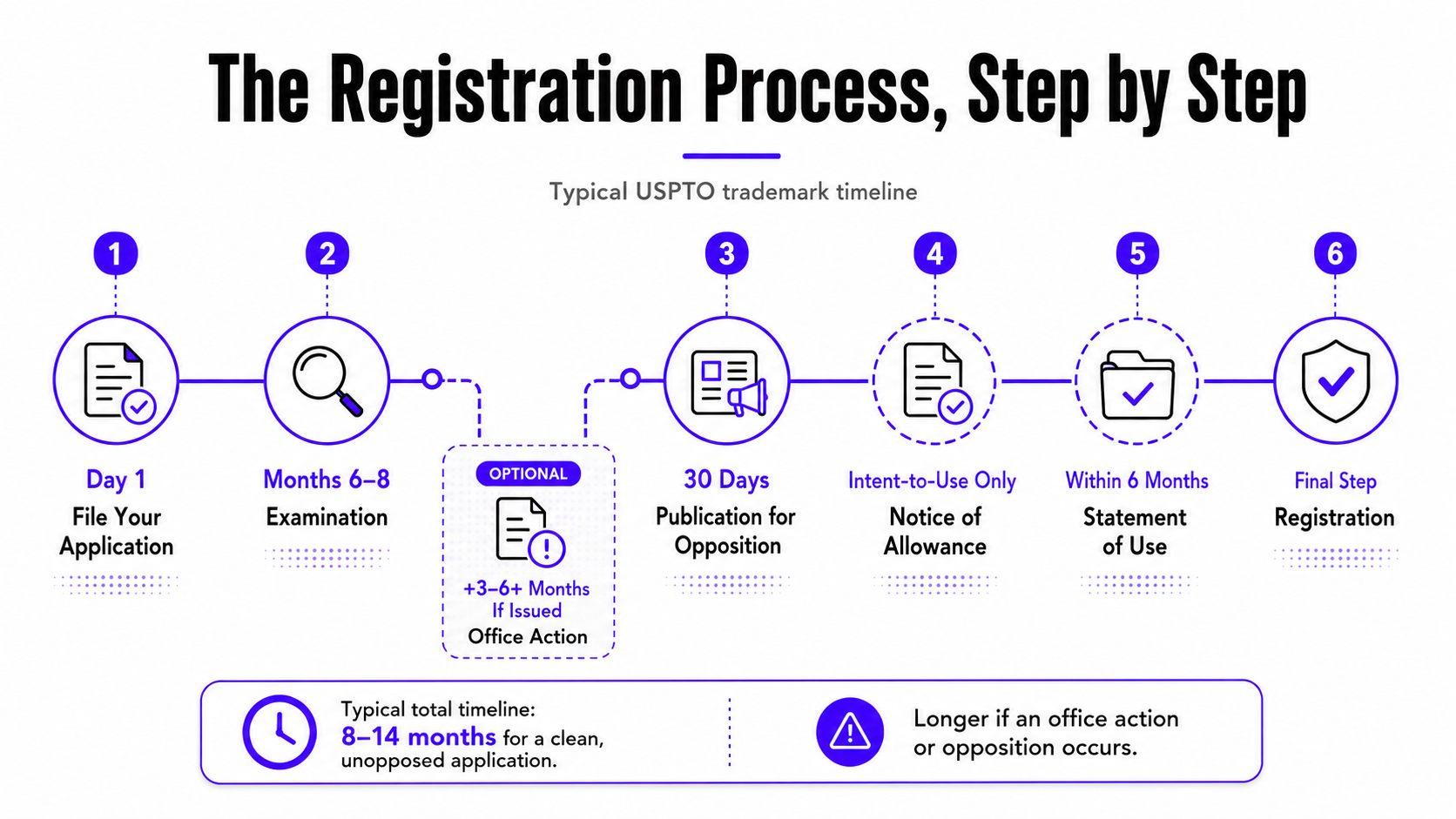
The Registration Process, Step by Step
- File Your Application — Day 1. Your application enters the USPTO queue.
- Examination — 6–8 months. An examining attorney reviews your mark for conflicts and compliance. This is the longest single wait in the process.
- Office Action (if issued) — Add 3–6+ months. Not every application gets one, but if it does, you have time to respond — and the clock resets while USPTO reviews your reply.
- Notice of Allowance — Intent-to-use filings only. Issued once your mark clears examination but before you've shown real-world use.
- Statement of Use — 6 months from Notice of Allowance (extendable up to 3 years in 6-month increments). You prove you're actually using the mark in commerce.
- Publication for Opposition — 30 days. Your mark is published in the Official Gazette. Anyone who thinks it conflicts with their rights can file an opposition here.
- Registration — If unopposed, your mark registers. Certificate issued.
Realistic total timeline: 8–14 months for a clean, unopposed application. Longer if there's an office action or opposition.
Anyone promising same-week registration isn't being straight with you.
Principal Register vs. Supplemental Register
Not every registration lands in the same place — and it changes what rights you actually walk away with. The USPTO doesn't keep one list of registered trademarks. It keeps two, and which one your mark ends up on changes what you actually walk away with.
Principal Register
The Principal Register is the strong one. It's reserved for names the USPTO considers genuinely distinctive — made-up words, or words with no real connection to what you sell. Land here and you get the full package: a nationwide legal presumption that you own the mark, the right to use the ® symbol, eligibility for Amazon's Brand Registry, and — after five straight years of use — the option to make your registration functionally unchallengeable.
Supplemental Register
The Supplemental Register is the consolation prize. Names too descriptive to qualify for the Principal Register can sometimes land here instead. You still get to use ®, and you can still sue in federal court, but you don't get the presumption of ownership — you'd have to prove your rights from scratch in a dispute, and there's no path to unchallengeable status while you stay here.
What Is Your Legal Investment?
Two separate costs. Any attorney who doesn't split them apart upfront isn't being transparent.
$499 (per class)
Legal Services
What this covers: A clearance check on your proposed name before we file, so you're not registering something that's going to get refused or challenged later. Preparation and filing of your application with the USPTO. Direct correspondence with the examining attorney if any questions come up during review. And my time walking you through what each stage of the process actually means, so you're never guessing what's happening with your own filing.
$370 (per class)
Government Fee
What this covers: This is the government's fee, not mine — it goes straight to the USPTO for examining and processing your application. It's non-refundable even if the mark gets rejected, which is exactly why the clearance check up front matters so much. One fee per class of goods or services you're registering under.
$869 (to start)
Total Investment
What this covers: Attorney fee plus USPTO fee, combined, for one class. No add-ons, no "final filing fee" sprung on you later, no hourly billing creep. If your business sells across more than one class of goods or services, each additional class carries its own $499 + $370. You'll know the full number before we file anything.
Do You Actually Need a Trademark Attorney?
You can legally file yourself. The honest question is what happens the moment something doesn't go smoothly. The USPTO's own free search tools and filing portal are genuinely useful, and worth knowing exist. What they don't do is tell you whether the name you're about to file is a good idea, or catch the conflict sitting one step outside the search terms you thought to use. That judgment call is the actual job.
Filing services (LegalZoom, Trademarkia, Trademark Engine):
- Basic database check, not a real clearance search
- No strategic class selection
- Office action response costs extra, from someone new to your file
Hiring me:
- Your Personal IP Strategist
- Knows what not to file, not just what to file
- Catches a conflict before you pay to discover it
- Already knows your file when the USPTO pushes back
What Happens After You File
Somewhere around month 3–8, an examining attorney reviews the application.
Filing isn't the finish line — it's the start of examination. What actually happens after you hit file. Here's what that actually looks like.
Office Actions: the part that scares people for no reason
A meaningful share of applications get at least one Office Action from the examining attorney. That word "action" makes it sound like something went wrong. Usually, nothing did — it just means the examiner has a question or an objection they need you to address before moving forward. The most common ones:
Likelihood of confusion — the examiner thinks your mark is too close to an existing registered mark covering related goods or services. This is exactly what a real clearance search is trying to catch before you ever file.
Merely descriptive refusal — the examiner believes your mark just describes what you sell rather than identifying who you are (the difference we cover in "Some Names Are Easier to Protect Than Others").
Specimen refusal — the proof you submitted showing the mark actually being used in commerce doesn't meet USPTO's standards. Common fix, not a dealbreaker.
Disclaimer requirement — if your mark includes a generic or descriptive word alongside a distinctive one, the examiner may require you to disclaim exclusive rights to that generic piece, while still registering the mark as a whole.
You get three months to respond, extendable once for a fee. Most office actions are resolvable with the right response — legal argument, amended evidence, a disclaimer, whatever the specific issue calls for. What actually kills an application almost never the office action itself. It's silence — missing the response deadline entirely. A difficult office action with a timely response still has a real shot. A simple one that nobody answers is dead on day 91.
Publication
Once your application clears examination — whether that took one pass or three rounds of office actions — it publishes in the USPTO's Official Gazette for 30 days. This is the public's chance to object if they believe your registration would harm them. Most marks pass through this stage without anyone filing an opposition. If nobody does, your mark registers.
Registration isn't permanent by default — it's maintained
This is the part people miss most: getting registered doesn't mean you're done. Between years 5 and 6, you're required to file a Section 8 declaration confirming the mark is still in active use. Then every 10 years, you renew. Skip either one, and the registration can be cancelled for abandonment — regardless of how strong the mark was, how much it's worth to your business, or how long you've owned it. A trademark isn't a certificate you frame and forget. It's an asset you have to actively keep alive.
Owning It Doesn't Mean the Job Is Done
A registration is leverage. It only works if someone's using it. Getting the registration certificate isn't the finish line — it's the tool. Trademark rights don't enforce themselves, and a mark that sits unused and unwatched can quietly lose strength even after it's registered.
Monitoring
Most infringement doesn't announce itself. Someone files a similar name months after yours, and unless you're actively watching the register — or paying a service that does — you'd have no idea until a customer mentions it or you stumble across it by accident. A real watch service checks new USPTO filings, state registrations, and often marketplace listings against your mark on a regular cadence, so a conflict gets flagged in weeks, not years. That timing matters more than people expect: the longer a conflicting mark sits out there unchallenged, the harder it becomes to argue you were actually protecting your rights, and the more that other business has built up around a name that's now tangled with yours.
Letters of Protest
Catch a conflicting application early — while it's still pending, before it registers — and you can flag it directly to the examining attorney reviewing it, before it ever gets far enough to require a formal opposition. You submit the evidence showing why the new application conflicts with your existing rights, and the examiner decides whether it's relevant to their review. It's faster and considerably cheaper than fighting a mark after it's already published, which is exactly why active monitoring is what makes this option available to you in the first place — you can't file a letter of protest against a conflict you never saw coming.
Oppositions and Cancellations
Every new application gets a 30-day publication window (extendable) where anyone who believes they'd be harmed can formally oppose it before it registers — filed with the Trademark Trial and Appeal Board, on grounds like likelihood of confusion or dilution. Miss that window and the mark registers, but the fight isn't necessarily over: a separate cancellation proceeding lets you challenge an already-registered mark, on similar grounds, or on abandonment or fraud. Worth knowing — even a mark that's reached "incontestable" status after five years isn't fully immune. It's protected from some challenges, not all of them; genericness and abandonment can still take it down.
A Direct Conversation
Most conflicts get resolved with a letter, not a lawsuit. A cease-and-desist letter, calibrated to the actual situation rather than swinging for maximum aggression, does most of the real work — it puts the other side on notice, and in most cases opens the door to a negotiated outcome: a coexistence agreement, a modification, sometimes a rebrand on their end. Litigation is the last resort, not the first move. It's expensive for both sides, slow, and most business owners genuinely would rather work it out than spend two years in discovery over a name.
None of this happens automatically. The registration gives you the standing to act. Whether you act is still on you.
Trademark Registration for Your Specific Situation
Founders, e-commerce brands, and startups each hit this differently.

Founders & Small Business
Most small business owners don't think about trademark timing until something forces the question — a competitor with a similar name, a copycat, a landlord or supplier asking for your registration. File early relative to your growth, not after you've already built something with the name. The gap between "I have an idea for a name" and "I've printed merch, signed a lease, and built a local following around it" is exactly where the cost of a conflict changes. Catch a naming problem before you've spent money on it, and it's a filing fee and maybe a different name. Catch it after you're known for that name in your market, and it's a rebrand — new signage, new packaging, a customer base that has to relearn who you are.

E-commerce & Amazon Brands
Registration isn't optional if you're serious about selling on Amazon — it's the access requirement for Brand Registry, and Brand Registry is what actually protects you on the platform. Without it, you have no real control over your own listings: no A+ content, no ability to report and remove counterfeit or knockoff listings using your brand name, no say over who else is allowed to sell "your" product under your name. E-commerce brands get copied fast, precisely because it's so easy to list a similar product under a similar name with zero friction. Registration is what gives you actual standing to do something about it instead of watching it happen.

Startups, SaaS & Apps
"We own the domain" feels like proof of ownership, but it isn't one — a domain is a lease, not a legal right, and it means nothing in a dispute over who actually owns the name. This becomes a real problem the moment outside money gets involved: investors and acquirers run IP diligence, and "we hold a federal registration" is a fundamentally different answer than "we own the URL." The founders who get burned here aren't careless — they're just heads-down building, and the name question never comes up until a term sheet does. By then, changing the name means redoing the app store listing, resetting App Store reviews and rankings, retraining users who already know you by the old name, and explaining to your cap table why this is happening mid-raise instead of before you ever filed.
Trademark Protection for Latino-Owned Brands
Bilingual practice — built for founders who've never had to translate their own brand story to get good legal advice about it.
A growing share of the fastest-growing brands in the U.S. right now are Latino-owned, and a disproportionate number are underprotected — not because the founders don't take their brand seriously, but because they've rarely had access to a trademark attorney who understood the name they built, the cultural reference underneath it, or spoke to them in the language they built it in. Roughly 0.15% of all U.S. attorneys are Latino IP attorneys specifically.
If your brand name is in Spanish or Spanglish on purpose — identity, not aesthetic — there's a legal wrinkle worth knowing: the USPTO and courts apply the doctrine of foreign equivalents, which can translate a foreign-language mark into its English meaning before evaluating whether it's descriptive or confusing. "El Toro" can get evaluated as though filed as "The Bull." That's not a reason to avoid a Spanish name — it's a reason to have that conversation with an attorney before filing, not after an office action raises it for you.
Segarra IP is a bilingual, Latino-owned trademark practice — built for founders who've never had to translate their own brand story just to get good legal advice about it.

Why Work With Segarra IP
A federal trademark practice, fully remote, serving founders anywhere in the U.S.

- Flat-fee pricing — legal fees and USPTO fees always itemized separately
- Strategy before paperwork — sometimes the right advice is what not to file
- Fully remote, serving all 50 states — trademark rights are federal
- Bilingual practice built for founders building culturally-rooted brands
Frequently Asked Questions
Should I trademark my business name, my logo, or both?
File them separately. If your logo ever changes, your name stays protected without needing to refile from scratch, and vice versa. Read the full answer.
Can I use my brand name before the trademark is approved?
Yes — using it is actually required to register it on a use-in-commerce basis. You can't use the ® symbol before registration completes; ™ is appropriate in the meantime. Read the full answer.
Do I need a trademark if I already formed an LLC?
Yes. An LLC is a business structure — it gives you no enforceable right to stop someone else from using a similar business name.
How do you actually check if a trademark name is available?
A real clearance search goes beyond the USPTO's own database — state registrations and common-law use matter just as much. Read the full answer.
What's the difference between TM and ®?
™ can be used any time. ® is reserved for marks that have completed federal registration — using it before then is a legal misstep.
Can I file my own trademark, or is hiring a lawyer worth it?
You legally can. Whether it's worth it depends on what a mistake costs you — a wrong class or missed conflict is usually far more expensive to fix after filing than to catch before it.
Ready to Talk?
One conversation, no obligation — find out what actually needs protecting before you spend a dollar filing it.